
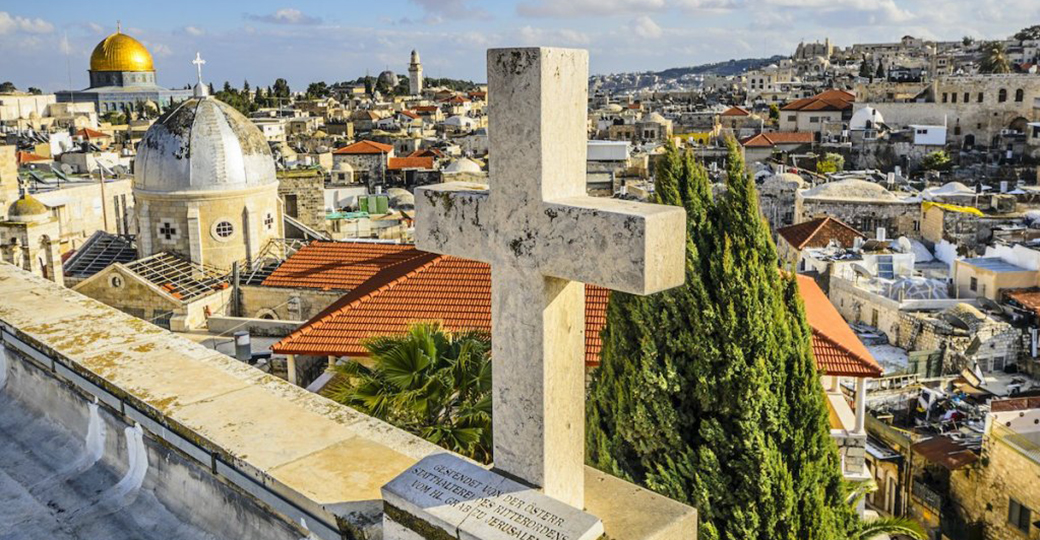
5 Day Holy Land Tour
Price for one tour per person
tour features
| Length | 5 Days / 4 Nights in a 4 star hotel |
|---|---|
| Highlights | Church of the Nativity, Mount of Olives Panorama, Garden of Gethsemane Prayer, Old City Via Dolorosa, Shepherd’s Field Bethlehem |
| Key Information | 5-Day Concentrated Pilgrimage, Jerusalem & Bethlehem Focused, Major Biblical Site Access, Professional Theological Guidance, Efficient Short-Stay Itinerary |

Your journey begins here
Condense a lifetime of spiritual discovery into a powerful 5-day journey through the heart of the Holy Land. This “Essentials” pilgrimage is designed for those seeking a focused encounter with the most significant sites of Jerusalem and Bethlehem.
From the panoramic heights of the Mount of Olives to the humble grotto of the Nativity, you will touch the very foundations of the Christian faith. Experience the profound silence of the Garden of Gethsemane, walk the ancient stones of the Old City, and find spiritual renewal in the places where the Gospel stories come to life. This short yet deeply impactful tour provides an efficient and prayerful way to experience the sacred heritage of Israel.
Places to visit
-
Mount of Olives: Witness the site of Christ’s Ascension and visit the Pater Noster Church, where the Lord’s Prayer is displayed in over 140 languages.
-
Gethsemane: Pray in the garden where Jesus spent His final hours of agony and visit the Church of All Nations.
-
The Old City of Jerusalem: Explore the historic Western Wall, the Pool of Bethesda, and follow the path of the Via Dolorosa.
-
Bethlehem: Enter the Church of the Nativity, see the Chapel of the Holy Innocents, and visit the Milk Grotto.
-
Beit Sahour: Stand in the Shepherd’s Field, where the angel announced the birth of Christ to the world.
-
St. Jerome’s Caves: See where the Bible was translated into the Latin Vulgate over 30 years of dedicated labor.
Trip Itinenary
Day- 1: Early arrival, meet and assist from Ben Gurion Airport, Tel Aviv/Sheikh Hussein Bridge or Allenby bridge and transfer to the hotel in Jerusalem /Bethlehem
Jerusalem, Mount of Olives,
its Churches Garden of Gethsemane. Mount of Olives: It is named so for the Olive groves that once covered its slopes. It stands 300ft above the city of Jerusalem. The Mount of Olives is where Jesus often went to pray. On his triumphal entry to Jerusalem before Passover on Palm Sunday, went down the mountain. He was by a crowd acclaiming him by waving palm branches and laying cloaks on the ground to honour Him. Also, it is the place from which Jesus ascended to heaven from the Church of the Ascension.
Pater Noster Church
is where Jesus Christ taught the Lord’s Prayer to his disciples. On the walls around the church and its vaulted cloister, translations of the Lord’s Prayer in 140 languages are inscribed on colourful ceramic plaques.
Church of the Ascension
is a shrine located on the Mount of Olives on the site believed to be the earthly spot where Jesus ascended into Heaven after his resurrection. It houses a slab of stone believed to contain one of his footprints.
Dominus Flevit Church:
Or the little teardrop church, located halfway down the western slope of the Mount of Olives, it is in this place where Jesus wept over the future fate of Jerusalem, it occurred during Jesus’ triumphal entry into Jerusalem on the first Palm Sunday, when crowds threw their cloaks on the road in front of him and shouted, “Blessed is the king who comes in the name of Lord” Looking down on the city, Jesus wept over it as he prophesied its future destruction. Enemies would “set up ramparts around you and surround you, and hem you in on every side . . . crush you to the ground . . . and they will not leave within you one stone upon another; because you did not recognize the time of your visitation from God. “Within 40 years, in AD 70, Jesus’ prophecy was fulfilled. Roman legions besieged Jerusalem and, after six months of fighting, burnt the Temple and levelled the city.
The Garden of Gethsemane
is the Garden of Olives, which hosts the oldest Olive trees in the world at the foot of the Mount of Olives, where Jesus underwent the agony and was arrested before his crucifixion. Walking distance from the Gethsemane garden is:
The Church of all Nations/Basilica of Agony:
This Church enshrines a section of bedrock where Jesus prayed before his arrest ad His tears penetrated the rock and are still visible to this day. End of tour, transfer to the hotel for dinner, rest, and overnight stay.
Day -2: Jerusalem Old City, Via Dolorosa, Church of the Holy Sepulchre:
Entering the Old City from the Kidron’s valley is through St. Stephen’s Gate (Lions Gate), passing St. Anne’s Church, home of Anne and Joachim, parents of the Blessed Virgin Mary. Pools of Bethesda where Jesus healed the paralyzed man, Church of the Condemnation and Flagellation where Jesus was condemned to death by crucifixion and was flogged by the Roman soldiers forced to carry His cross through the Via Dolorosa in Latin which means “Way of Grief,” “Way of Sorrow, “it consists of 14 stations marked by nine Stations of the Cross and the remaining five stations being inside the Church of the Holy Sepulchre. It is a processional route believed to be the path that Jesus walked on the way to his crucifixion. The winding route from the Antonia Fortress west to the Church of the Holy Sepulchre is about 600 meters (2,000 feet).
Church of the Holy Sepulchre:
Is the site where Jesus Christ was crucified and died on the cross. The place was shaped like a skull; thus came the name Golgotha. The church was built by Helena, the mother of Constantine, on her pilgrimage to Jerusalem,m where she found a relic of the original cross.
Mount Zion, Church of St Peter in Gallicantu/Church of the Cock Crow/Upper Room, Wailing Wall Mount Zion:
Is a hill just outside the walls on the southern end of the Old City. The hill has been called Mount Zion since sometime in the Middle Ages, even though Jewish scripture refers to the Temple Mount by the same name. Among the important sites and landmarks on Mount Zion are the Room of the Last Supper and the Dormition Abbey
Church of St Peter of Gallicantu/Cock Crow/:
According to tradition, this was the place of the palace of high priest Caiaphas, where Jesus was brought to jail after his arrest. Its name is given after the story of Peter’s triple denial of Christ and the cock crowing three times.
Dormition Abby:
is one of the three earliest churches in Jerusalem and was regarded as the mother of all Churches. The Catholics believe that it is the site wherethe Virgin died, or rather “fell asleep “as the name suggests.
The Upper Room (Cenacle):
The room is located on top of Mount Zion, where Jesus had shared the Last Supper with his disciples the night before he died, and during this meal, he instituted the Eucharist, which is the most momentous event of the Christian faith. Also, the descent of the Holy Spirit on His disciples at Pentecost, which is recognized as marking the birth of the Christian Church.
Wailing Wall:
It is the most sacred site to the Jewish people, who believe the remains of the wall to be of the great Jewish temple or the wall surrounding the courtyard of the temple. While Muslims consider the wall to be part of Al-Aqsa Mosque, built in the seventh century by the Umayyads
Southern Steps:
At the southern edge of the Western Wall, just around the southwest corner where Robinson’s Arch is located, this spot was the main entrance for the common man to enter the Temple, the stairs are irregular, with both original and replaced stones, which forced the faithful to pay attention as they ascended the alternating wide and narrow steps. It also prevented a hurried approach to the Temple. End of tour, transfer to the hotel for dinner, rest, and overnight stay.
Day 3: Jericho, Dead Sea, Qumran, Masada: The name Jericho means “City of palms” and is known to be the oldest town in the world. It was there that the Israelites supposedly brought down its walls with a great shout and trumpet blasts when they entered the Promised Land. Here, Jesus performed the miracle of healing Bartimaeus, the blind beggar, and dined with Zacchaeus, the rich tax collector. And both Cleopatra and Herod the Great coveted this lush oasis. Water from Jericho’s powerful perennial spring provides irrigation for abundant fruit, flowers, and spices. Prophet Elisha Spring: Called as well the Prophet’s Fountain/Elisha’s Fountain) is a fresh water spring near the archaeological mound of Tel Jericho or Ancient Jericho (Tell es – Sultan), where the remains of the oldest fortified city were found, dating back to about 8,000 BC. It is a UNESCO World Heritage site. It is believed that Prophet Elisha purified the waters by throwing salt into it. Zacchaeus tree: Is the Sycamore tree, which is over 2000 years old and is located in the city centre of Jericho. This is the tree Zacchaeus climbed when Jesus was passing through the town to see him, as he was a very short man and couldn’t see over the heads of the crowds. Also, it is the place where Jesus cured Bartimaeus the beggar from blindness. The Good Shepherd Church is the site where Jesus restored Bartimaeus’s sight and converted the rich Zacchaeus, performing his ministry of the Good Shepherd. Qumran: Is the place where the Dead Sea Scrolls were discovered in caves. Located on the north-western shore of the Dead Sea, Qumran is located between Jerusalem and the major Dead Sea beaches and attractions such as Ein Gedi and Masada. The Dead Sea: Called also the Sea of Lut, Sea of Salt It is significant because it is the lowest place on Earth. It is an inland body of water appropriately named due to the fact that it’s extremely high in salt and mineral-rich waters, which are not conducive to sustaining life. In fact, the Dead Sea is nearly ten times saltier than any of the world’s oceans. Masada Is the ancient fortress overlooking the Dead Sea. A cable car and a winding path climb up to the fortifications. Among the ruins is King Herod’s palace and a Roman-style bathhouse with mosaic floors. It is famous for the last stand of the Zealots, where the 960 living at the top of the plateau chose to commit suicide rather than to fall into the hands of the Romans alive. Masada is a UNESCO World Heritage. End of tour, transfer to the hotel for dinner, rest, and overnight stay.
Day 4: Bethlehem, Church of Nativity, St. Jerome’s Cave, Milk Grotto, Beit Sahour Shepherds Field Church/Basilica of Nativity: Is considered one of the major Christian sites due to the birth of Jesus in the grotto. In 326, Constantine and his mother, Helen, built the church over the grotto, which is the oldest site for worship by Christians. The Basilica is the oldest major Church in the Holy Land. St. Catherine’s Church: Located in the northern part, adjacent to the Basilica of the Nativity in Bethlehem. It works as a parish church in Bethlehem and a Franciscan monastery. There is a complex of caves underneath the church. It was dedicated in 1347 to St. Catherine of Alexandria. This is the church where the Latin Patriarch of Jerusalem celebrates Midnight Mass on Christmas Eve. St. Jerome’s Cave is a two-room cave that lies underneath the Church of St. Catherine on the right-hand side of the nave. Steps lead down to a complex of subterranean chambers. The first cave on the left at the bottom of the stairs is identified as the Chapel of the Holy Innocents. This is said to be the burial place of infants killed by King Herod in his attempt to eliminate the newborn “King of the Jews. At the end of the right side are the rooms where St. Jerome lived and spent 30 years translating the Scriptures from Hebrew and Greek into Latin. The adjacent caves have been identified as the burial places of Jerome (whose remains were later taken to Rome). Milk Grotto: Is the place where the Holy Family found refuge during the Massacre of the Innocents, before they could flee to Egypt. The name is derived from the story that a “drop of milk” of the Virgin Mary fell on the floor of the cave and changed its colour to white. There are three different caves, which are visited by some in the hope of healing infertile couples, the shrine being a place where prayers for children are miraculously answered. Beit Sahour is 2 km east of Bethlehem. It Is the place where the Angel of the Lord appeared to the Shepherds and informed them about the birth of Jesus in a grotto in Bethlehem. and Shopping: Bethlehem is famous for its souvenir shops that sell Olive Wood carvings and hand-painted religious icons. End of tour, transfer to the hotel for dinner, rest, and overnight stay.
Day 5: Departure Home
Whats Included
Items included are:
- 1
- 2
- 3
- 4
Whats Not Included
Items not included are:
- 1
- 2
- 3
- 4
transport & guide
Private Car with Driver for Journey
Nulla aliquet porttitor lacu luctus acmans tords posuere. Sapien faucibuse molestie acd feugiat sed quis blandit.
accommodation
Stay in a 4 Star Hotel incl. Breakfast
Nulla aliquet porttitor lacu luctus acmans tords posuere. Sapien faucibuse molestie acd feugiat sed quis blandit.
other tour services
Enjoy Natural Scenery & Local Life
Nulla aliquet porttitor lacu luctus acmans tords posuere. Sapien faucibuse molestie acd feugiat sed quis blandit.

Reviews
There are no reviews yet.